Polo Grounds

Polo Grounds

Friday, August 12, 2016

Mark Teixeira's retirement

The last week has yielded a lot of headlines in the MLB, mostly regarding players who are reaching the end of their playing careers. Lost among the headlines about A-Rod's mistreatment by the Yankees, Ichiro's 3000 MLB hit and Prince Fielder's sudden (and very sad) retirement was the announcement by three time All-Star 1B Mark Teixiera, who announced on 8/5 that the 2016 season would be his last season in baseball.


Teixeira looked to be done after the 2014 season, after hitting a combined .209/.308/.391 with 25 home runs over 571 PA between an injury shortened 2013 and 2014. Tex bounced back in 2015 with 31 home runs, 79 RBI's, and a .255/.357/.548 line, good enough to earn him his 3rd all-star nod at age 35. After that season it looked like Tex might have a few years left, but this season has been abysmal for the switch-hitter. Through 83 games Tex has slashed .197/.287/.334 with ten home runs and 28 RBI's. Teixeira announced last Friday that he will be retiring at the end of the season, so he has about six weeks left on a career that has seen him amass 404 home runs, making him the 5th switch hitter with over 400 HR, joining Mickey Mantle, Chipper Jones, Eddie Murray and former teammate Carlos Beltran.

I have two favorite facts about Mark Teixeira:
1) His batting average throughout his career is the perfect example of why the shift works (explained below).
2) He was involved in one of the most lopsided "Star for prospects" deadline trades in recent memory.
 
1) From 2003-2009, Mark Teixeira was a monster. He averaged 35 home runs and 114 RBI's per season while slashing a blistering .290/.378/.545. He looked well on his way to 500 home runs and a Hall of Fame career. Then, something changed in 2010. The shift had begun to gain in popularity, and teams started shifting on Tex when he swung it from the left side. From 2010-2016, Tex has averaged 23 home runs and 69 RBI's, but his slash line has dropped to .239/.336/.461. Part of this can be contributed to age/injury/etc. but the drop between 2009 and 2010 is what really startles me:

2009: .292/.383/.565  39 HR, 122 RBI's
2010: .256/.365/.481  33 HR, 108 RBI's

2009 was Tex's age 29 season, and his first with the Yankees. 2010 was Tex at age 30, and also still with the Yankees. His power #'s regressed slightly toward his career averages, but what happened to his batting average? A 36 point drop in one season, especially when he was not injured (601 AB in 2009, 589 in 2010) is pretty startling. Digging a little deeper, Tex's BaBIP (Batting average on balls in play) in 2009 was .302, and it dropped down to .268 in 2010. His career BaBIP is .283, so it appears at first that Tex just got a little lucky in 2009, and a little unlucky in 2010 (since BaBIP is largely considered luck). However, this is where I think the shift comes into play: From 2003-2009 (the "pre-shift" era) Tex had a career BaBIP of .308. From 2010-current, it has dropped to .246, over a 50 point drop. There are plenty of other factors involved, including declining speed (which means less infield hits), more infield pop-ups (11% from 03-09, 15% from 10-16) and a slight drop in his hard contact %. However, I think the biggest factor is the shift. Teams realized that Tex gets a lot of his hits on ground balls up the middle or hard ground balls pulled to right field. Once they shifted a third infielder on that side of the diamond, Tex was making outs on grounders he used to get hits on. That would help explain such a dramatic drop in his batting average, especially since many of his other peripheral stats (K%, BB%, line drive %, etc) stayed relatively constant. The last factor that helps prove this point is Tex's pulled ball %, which has stayed constant at around 52% for his entire career. How could a guy who pulls the ball 52% of the time, with a pretty consistent % of line drives, and similar rate of strikeouts, lose 50 points on his batting average on balls in play? Well, if the other teams starts playing him to where he hits the ball, and he can't follow the old baseball adage of "hit em where they ain't" then there's your answer. Tex never adjusted and started going the opposite way (on his LH swing at least) and it cost him dearly in the batting average department.


2) On July 31, 2007 Mark Teixeira was traded from the Texas Rangers to the Atlanta Braves for four prospects, a move the Braves made in part to acquire a superstar in his prime for the stretch run of the 2007 season. Tex did not disappoint, hitting 17 home runs in only 54 games with a .317 BA. However, the Braves went 28-27 the rest of the season and missed the play-offs. Tex his .283 with 20 HR in 103 games the following year, before being traded again, this time to the Angels for fellow 1B Casey Kotchman. Over his brief time with the Braves, Teixeira hit .295/.395/.548 with 37 HR and 134 RBI's in 157 games, good for a 6.0 WAR. Not bad for just a couple of prospects right? Except when the four prospects go on to become integral pieces of a Texas Rangers team that came within 1 strike of winning the World Series (twice) - then your trade doesn't look quite as good. The four players the Rangers acquired for a year of Mark Teixeira were:

Elvis Andrus (22.4 WAR w/ Texas)
Neftali Feliz (8.4 WAR w/ Texas)
Matt Harrison (9.2 WAR w/ Texas)
Jarrod Saltalamacchia (0.5 WAR w/ Texas)

Adding this up, the Rangers got four players who were worth roughly 40.5 wins, and nearly a World Series title. Injuries to Harrison and Feliz derailed their careers, which could have made this trade even more of a loss for Atlanta. Meanwhile the Braves got a two great half seasons from Teixeira, but nothing to show for it. Just goes to show the dangers of deadline trades for prospects. This still isn't as bad as my all-time favorite deadline deal, when the Indians traded an aging Bartolo Colon (in 2005) to the Nationals for three prospects: Grady Sizemore, Cliff Lee and Brandon Phillips. Ouch.

Last point on Mark Teixeira: Is he a Hall of Famer? Teixeira will surely go down as one of the best switch-hitters of all time and was an outstanding defensive 1B. Early in his career, Tex could do it all: hit for power, for average, had decent speed, and was an elite defensive 1B. Injuries and the shift slowed him considerably, however, and as it stands he falls into the category of great, but not Hall of Fame great (also frequently referred to as the Hall of Very Good). There are many players who were as good or better than Tex who are not in the Hall, including Jeff Bagwell (who will be soon) Carlos Delgado, Fred McGriff, Tino Martinez and Andres Galarraga.

I wish Tex all the best in retirement, he was a fun player to watch and will be missed.


Friday, April 29, 2016

Torii Hunter and the Hall of Fame

(My goal during the 2016 season is to write one blog post per week and publish them every Friday. Many of them will be Hall of Fame evaluations, but I am happy to get feedback on anything you all want to read about, or specific players you would like me to evaluate. Thanks for reading!)

Coming off a 2015 season where he eclipsed 80 RBI's for the 7th consecutive year, and reached 20 home runs for the 11th time in his career, former Twins/Angels/Tigers outfielder Torii Hunter decided to call it a career. The 40 year old finished his 19 seasons with 2452 hits, 353 home runs, 1391 RBI's, 195 steals and a slash line of .277/.331/.461. Hit hitting stats were far above average, but it was his defense that most people will remember, and part of what makes him a contender for the Hall of Fame.

For Torii Hunter and the Hall of Fame:


A list of position players with 9+ Gold Gloves and over 350 home runs includes Mike Schmidt, Willie Mays, Ken Griffey Jr, Andruw Jones, Al Kaline and Hunter. Everyone on this list is a HOFer except Jones, who is not eligible yet. Torii had a rare gift to blend outstanding defense and blazing speed with raw power, and very few other players can match those skills.

Hunter ranks in the top 100 all-time in numerous hitting categories, including total bases (80th), doubles (63rd), home runs (90th), RBI's (80th), and extra base hits (69th). Additionally, his power-speed #, calculated by Bill James, ranks 49th all time, ahead of guys like Mickey Mantle, George Brett and Carl Yastrzemski. Simply put, Torii was one of the best hitters of his generation and played long enough at a high enough level to accrue offensive numbers that rival some of the greatest of all time.

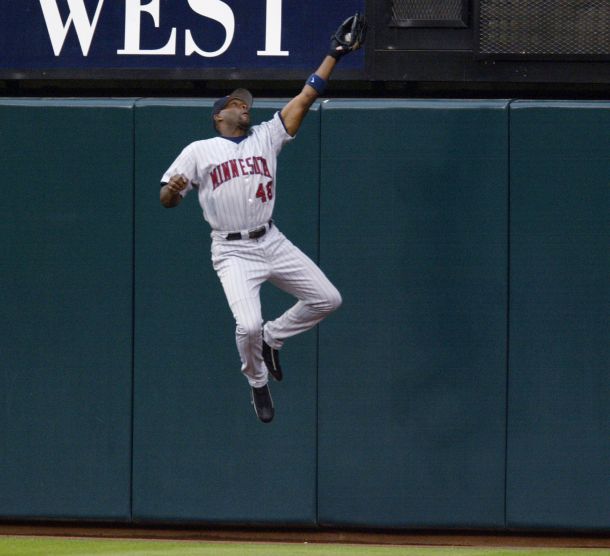
Defensively, Torii was a wizard in the outfield. Nicknamed Spider-Man, Hunter was known for his ability to get to almost anything in the outfield, and of course for robbing numerous home runs, including infamously taking away a home run from Barry Bonds in the 2002 All-Star game. Hunter will be remembered as one of the best defensive centerfielders of all-time. Despite having played in the same era as Jim Edmonds, Andruw Jones and Ken Griffey junior, Hunter was able to stand out as one of the true great centerfielders of his era, and of all-time.


Against Torii Hunter and the Hall of Fame:


Torii Hunter does not stack up favorably to the centerfielders who have already been enshrined in Cooperstown. The average Hall of Fame centerfielder has a 71.1 WAR, a 44.5 seven year peak WAR, and a JAWS score of 57.8 (more explanation of JAWS here) Torii's numbers for comparison are a 50.3 WAR, a 31.2 seven year peak WAR, and a 40.6 JAWS score. All of these fall considerably short of what Hall of Famers look like at his position, and his closest comparisons are Devon White, Brett Butler and Ellis Burks. All great players, none whom are in the Hall of Fame.

Torii was a great hitter, but he was never the best centerfielder in the league, and he never led the league in any hitting categories. Being the best in the game is not a requirement for HOF enshrinement, but Torii only finished top ten in MVP voting once, and was never truly a "dominant" player.
The Hall of Fame is primarily made up of 3 types of players; guys who were purely dominant for a period of time, (Ralph Kiner only played 10 seasons, but led the league in home runs in 7(!) of them) the "compiler" AKA guys who reached big career milestones after having very lengthy careers (Craig Biggio eclipsed 3000 hits in his 20th MLB season, 9 years after his last All-Star game appearance) and the third type, which is a combination of both (reserved for the true greats; Mays, Aaron, Mantle, Musial etc.)
Hunter doesn't fit well in any of these categories - he played 19 years but didn't reach any HOF milestones (500 hits short of 3000, 150 home runs short of 500, 600 RBI's short of 2000). Likewise, as I stated earlier, Hunter never led the league in any hitting categories, and his "Gray Ink" score (which measures a player based on top ten finishes in various hitting categories) is 29, whereas the average Hall of Famer has a score of 144.

Hunter's closest statistical counterparts, according to baseball-reference, are Chili Davis, Dave Parker, Carlos Beltran, Carlos Lee and Dwight Evans. Beltran has a chance of gaining enshrinement once his career is up, but Davis, Parker, Lee and Evans are all not Hall of Famers. Hunter seems to fit in more with this group than with HOF outfielders like Kirby Puckett, Andre Dawson and Jim Rice.

Verdict:

Torii was a great baseball player, but he falls short of being Hall of Fame caliber in my opinion. There are a lot of outfielders who I think are more deserving than him who have not gotten their due, including Jim Edmonds, Larry Walker, Kenny Lofton and Tim Raines. Hunter was a great centerfielder, but does not cross over into the echelon of Hall of Famer in my book.


Prediction:

Predicting what the Hall of Fame voters will do has become more and more challenging, especially trying to look five years into the future, when Hunter will be eligible. However, seeing as Jim Edmonds got bumped on his first year on the ballot I don't see a lot of hope for Hunter, who wasn't quite as good as Edmonds was. On the flip side, a lot can change in five years and Hunter was a very popular player during his career. I don't see that alone being enough to get him into Cooperstown, however.


Thanks for reading! Feedback is always appreciated.

Friday, April 22, 2016

The All-Dave team

(My goal during the 2016 season is to write one blog post per week and publish them every Friday. Many of them will be Hall of Fame evaluations, but I am happy to get feedback on anything you all want to read about, or specific players you would like me to evaluate. Thanks for reading!)

"Did I ever tell you that Mrs. McCave
Had twenty-three sons and she named them all Dave?
Well, she did. And that wasn’t a smart thing to do."
- "Too Many Daves" (Dr. Seuss)


While a family of 23 young boys named Dave McCave would be quite the nightmare, a baseball team full of Daves actually wouldn't be too bad. Being a biblical name, Dave/Davids have been around for centuries, and there have been Daves at the MLB level basically forever. But what does a roster look like if you take the 25 best Daves of all-time? Let's take a look:

Catcher: Dave Nilsson (1992-1999) 10.5 WAR, 1999 All-Star.


First Base: Dave Kingman (1971-1986) 17.3 WAR, 3 time All-Star, 2 time HR Champion (1979, 1982)


Second Base: Davey Lopes (1972-1987) 42.2 WAR, 4 time All-Star, 1978 Gold Glove Award, SB leader (1975, 1976)


Shortstop: Dave Bancroft (1915-1930) 48.5 WAR, 2 top 10 MVP finishes, 2004 hits, 1971 Hall of Fame Inductee


Third Base: David Wright (2004-active) 49.9 WAR, 7 time All-Star, 4 top 10 MVP finishes, 2 gold gloves, 2 silver sluggers


Left Field: Dave Parker (1973-1991) 39.9 WAR, 7 time All-Star, 1978 MVP Award, 3 other top 5 MVP finishes, 3 Gold Gloves, 3 Silver Sluggers, 2 batting titles


Center Field: Dave Winfield (1973-1995) 63.8 WAR, 12 time All-Star, 3 top 5 MVP finishes, 7 Gold Gloves, 6 Silver slugger Awards, 3110 hits, 2001 Hall of Fame Inductee


Right Field: David Justice (1989-2002) 40.5 WAR, 3 time All-Star, 2 Silver Slugger Awards, 1990 Rookie of the Year


Designated Hitter: David Ortiz (1997-active) 51.1 WAR, 9 time All-Star, 5 top 5 MVP finishes, 6 Silver Slugger Awards, 2006 HR champ


Batting order: (162 game averages)

1. Winfield - CF                    .283/.353/.475   25 hr 100 rbi   130 OPS+
2. Wright - 3B                       .298/.377/.492   25 hr 100 rbi   134 OPS+
3. Ortiz - DH                         .284/.378/.548   36 hr 116 rbi   140 OPS+
4. Justice - RF                      .279/.378/.500   31 hr 102 rbi   129 OPS+
5. Parker - LF                       .290/.339/.471   22 hr 96 rbi     121 OPS+
6. Nilsson - C                        .284/.356/.461   20 hr 91 rbi    110 OPS+
7. Kingman - 1B                   .236/.302/.478   37 hr 101 rbi   115 OPS+
8. Bancroft - SS                    .279/.355/.358   3 hr 50 rbi       98 OPS+  (12 SB)
9. Lopes - 2B                        .263/.349/.388   14 hr 55 rbi     107 OPS+ (50 SB)

Man oh man this team would mash. There are 100 different ways to set up this batting order, but no matter how you set it up, this team is going to get guys on base and score some runs. Winfield is a first ballot Hall of Famer, and even though he's not a traditional lead-off guy, I think he'd serve this team well there. He is followed by David Wright and David Ortiz, two active guys who have put together Hall of Fame credentials (although neither is likely to make it: Wright because he's been too injury prone, Ortiz because of steroids). Follow that up with David Justice and Dave Parker, two great hitting corner outfielders who both could make an argument for HOF induction (Parker in my opinion should be in - Justice is close). Dave Nilsson left the MLB in the prime of his career, but was able to put up some excellent numbers in his brief 8 years here in America, including an outstanding .356 OBP. Kingman was Adam Dunn before Adam Dunn, a guy who couldn't do anything but hit home runs, which he did in droves. Follow that up with our other Hall of Famer, Dave 'Beauty' Bancroft, an outstanding defensive SS who narrowly edged Dave Concepcion for the starting role, and Davey Lopes, a speed demon and good defensive 2B who rounds out the order quite nicely.

Bench


Dave Valle - C
Dave Concepcion - SS
Dave Henderson - CF
Davey Johnson - 2B/1B
Dave Magadan - 1B/3B
David DeJesus - OF

There were a lot of good options to make the bench on this squad. In fact, outside of Concepcion and Dave Henderson, every other spot was a toss up. Valle was a solid catcher for the M's and serves as valuable insurance behind the dish. Concepcion was a no-brainer, he narrowly missed starting and was an excellent defensive SS. Davey Johnson and Dave Magadan give this team plenty of depth in the infield, as well as good options to pinch hit off the bench. Likewise, both Henderson and DeJesus have experience in center field, which helps give them some defensive options. Neither were slouches with the bat either. Overall, not a bad group of guys to have represent you on the pine.

Narrowly missing the cut: David Bell, Dave Cash, David Murphy, and David Eckstein.


Rotation

David Cone (1986-2003) 5 time All-Star, 1994 Cy Young Award, 2 time strikeout leader (1990, 1991) Two 20 win seasons (1988, 1998) 5 World Series Rings, 121 ERA+


Dave Stieb (1979-1998) 7 time All-Star, 4 top 10 Cy Young finishes, 1985 ERA leader, 122 ERA+


David Price (2008-active) 5 time All-Star, 2012 Cy Young, 2 time ERA leader (2012, 2015) 2014 Strikeout leader, 20 wins in 2012, 124 ERA+


Dave Stewart (1978-1995) 1989 All-Star, 4 top 5 Cy Young finishes, 4 consecutive 20 win seasons, 1989 WS MVP, 2 time ALCS MVP (1990, 1993) 100 ERA+


David Wells (1987-2007) 3 time All-Star, 2 top 3 Cy Young finishes, 239 Wins, 2 World Series rings, 108 ERA+


Another situation, similar to the batting order, where you could rearrange the rotation and still get the same results. I went R/R/L/R/L, but any of Stieb, Price, Stewart or Cone could be the ace. Currently this rotation has 0 Hall of Famers, but you could make a case that they should have 3, and Price is well on his way if he continues to pitch like he has. Stieb was one of the most dominant pitchers of the 1980's, racking up seven all-star appearances and twice leading the league in ERA+, with a blistering 171 in 1985. Stewart was a postseason machine, and four consecutive 20 win seasons shows he knew how to pitch in the regular season as well. Price has been a top 5 pitcher in the game for the last 7 seasons, and at age 30 still has a lot of years ahead of him. David Cone, in my opinion, should be in the Hall of Fame. He was a top 5 pitcher throughout the 90's, a strikeout machine, and won 5(!) World Series championships. He'd be in if I had any say. Wells was an extremely solid LHP in his prime. He threw forever, racking up 239 wins over 20 years in the bigs and is about as solid of a #5 starter as you can find.

Bullpen


Dave McNally (1962-1975)
Dave Dravecky (1982-1989)
David Robertson (2008-active)
Dave Smith (1980-1992)
Dave Righetti (1979-1995)

The bullpen was very hard to choose, there have been a lot of Dave/Davids who have pitched in the Major Leagues, so picking the best ones was somewhat of a toss up. I know it is kind of cheating, but McNally and Dravecky were too good to leave off this roster, so I selected them as relievers even though they were both starters for the majority of their careers. Either of these two could step into the rotation and it wouldn't miss a beat. Righetti is one of the best relievers in the games history, having made the "Eckersley" transition from frontline starter to lights out closer look very seamless. Dave Smith amassed over 200 saves and was one of the first to do so, and David Robertson has looked like an outstanding shut down reliever since his debut with the Yankees in 2008.


Future additions


Currently, the only Dave/David in the Minors who seems likely to make an impact at the MLB level is Colorado Rockies outfield prospect David Dahl. Dahl was the 10th overall pick in the 2012 MLB draft and was ranked as a top 100 prospect from 2013-2015 by Baseball America, MLB.com and baseballprospectus.com. A ruptured spleen has slowed his development through the minors, but Dahl has still managed to hit .306 and steal 60 bases over his 286 MiLB games (as of 4/18). The Rockies will give him some time to prove himself (he hasn't played above AA yet) but it wouldn't be surprising to see him get a chance at the MLB level sometime in 2017. He may never crack a starting spot in the all-Dave lineup over Parker, Justice or Winfield, but he certainly has the potential to produce at a solid level in the Major Leagues.

Final Thoughts

This team wouldn't beat the all Mike/Michael team, or the all John team, or even the all Will/Willie team, but it would hold its own against a lot of other "Name" teams. I certainly wouldn't want to face a line-up with David Wright, Dave Winfield and David Ortiz in the middle of it, nor would I want to face a pitching staff with Dave Stieb, David Price and David Cone 1-3.

As always, I welcome feedback of any kind. This was a fun team to make, and there is certainly a lot of debate about who would start, what the batting order looks like, and even a few players who just barely missed the cut. Feel free to leave a comment below and let me know what you think!

Saturday, April 16, 2016

The Seattle Mariners all-time team

(My goal during the 2016 season is to write one blog post per week and publish them every Friday. Many of them will be Hall of Fame evaluations, but I am happy to get feedback on anything you all want to read about, or specific players you would like me to evaluate. Thanks for reading!)

The Seattle Mariners are a funny franchise. They have had some of the most incredibly talented players in MLB history play for their team, yet they have never made it to a World Series. They have a 0.467 winning percentage and have had 28 losing seasons (out of 40), yet they have the single most successful regular season of all time (the magical 2001 season of 116 wins). They are known as a team built around pitching, yet most of their best players have been hitters, including two players with over 600 home runs, and one player fast approaching 3000 hits.

Even though the franchise hasn't been around that long, a 25 man roster of all Mariners players would not be a team many people would want to play. Taking into account only their numbers while on the Mariners, let's take a look at the All-Time Mariners roster:

C: Dan Wilson (1994-2005) 13.5 WAR, 1996 All-Star


Catcher has historically been a pretty weak position for the Mariners, with Wilson being the one exception. From 1994 through 2005, Wilson played backstop for the M's, accruing a 13.5 WAR, mostly due to his work on the defensive end. His best year came in 1996, when he hit .285 with 18 home runs and 83 RBI's. Otherwise, he was a slightly above average hitter and a great defensive catcher, as well as being a team leader and, eventually, a member of the Seattle Mariners Hall of Fame.

1B: Alvin Davis (1984-1991) 19.9 WAR, 1984 All-Star, 1984 Rookie of the Year


It was hard to choose who would start between Davis and John Olerud, but it is pretty hard to leave the guy nicknamed "Mr. Mariner" out of the starting line-up. Davis came up with the Mariners in 1984 as a 23 year old and immediately made his mark, hitting .284 with 27 home runs and 116 RBI's, landing himself on the All-Star team and finishing first in Rookie of the Year voting. He went on to play seven more seasons with the Mariners, hitting 160 home runs while batting .280 with a spectacular .380 on base percentage. Mr. Mariner was the first great Seattle baseball player.

2B: Bret Boone (1992-1993, 2001-2005) 19 WAR, 2 time All-Star, 3 Gold gloves, 2 Silver Sluggers, 2 Top 10 MVP finishes


Strangely enough, 2B is a position the Mariners have historically been very good at. From Harold Reynolds to Joey Cora to Jose Lopez to Robinson Cano, they have almost always had someone solid at the keystone. None better than Bret Boone, however, who mashed his way to 2 All-star games and 2 silver slugger awards, while also capturing three gold gloves. His 37 home runs and league leading 141 RBI's in 2001 were a huge part of the M's success that year, and his 143 home runs as a member of the Mariners places him 7th all-time in franchise history. Solid defense and above average power make him a clear choice for 2B on this team.


SS: Alex Rodriguez (1994-2000) 38 WAR, 4 time All-Star, 4 Silver Slugger Awards, 2 top 5 MVP finishes.


While not remembered quite as fondly as many of the names to follow, A-Rod no doubt made his mark as one of the best Mariners of all-time. Shortstop has not been the Mariners' strongest position, but what A-Rod was able to accomplish in his seven years in Seattle is nothing short of remarkable. While in Seattle, A-Rod made 4 all-star teams, won 4 Silver Slugger awards, won the 1996 batting title, had a 40/40 season in 1998 and twice finished in the top 5 in MVP voting. He hit .309 with 189 home runs and 595 RBI's, and there is really little doubt that he is the best SS to ever don a Mariners uniform. 

3B: Kyle Seager (2011-active) 17.5 WAR, 2014 All-Star, 2014 Gold Glove winner


Honestly this position was a toss up between Seager and Adrian Beltre. Beltre statistically has a slight, slight advantage over Seager but I picked Kyle for a few reasons: 1) Assuming he stays healthy he will blow Beltre's numbers in Seattle out of the water, and 2) Beltre was generally considered a disappointment, having put up mediocre numbers in Seattle while putting up excellent numbers in LA, BOS and TEX. Seager signed a 7 year, 100 million dollar contract and assuming he continues to make slight improvements to his game should become one of the best Mariners of all-time, and will certainly be their best 3B ever.

LF: Jay Buhner (1988-2001) 22.9 WAR, 1996 All-Star, 1996 Gold glove winner, top 5 MVP finish in 1995, 3 consecutive 40 HR seasons (1995-1997).


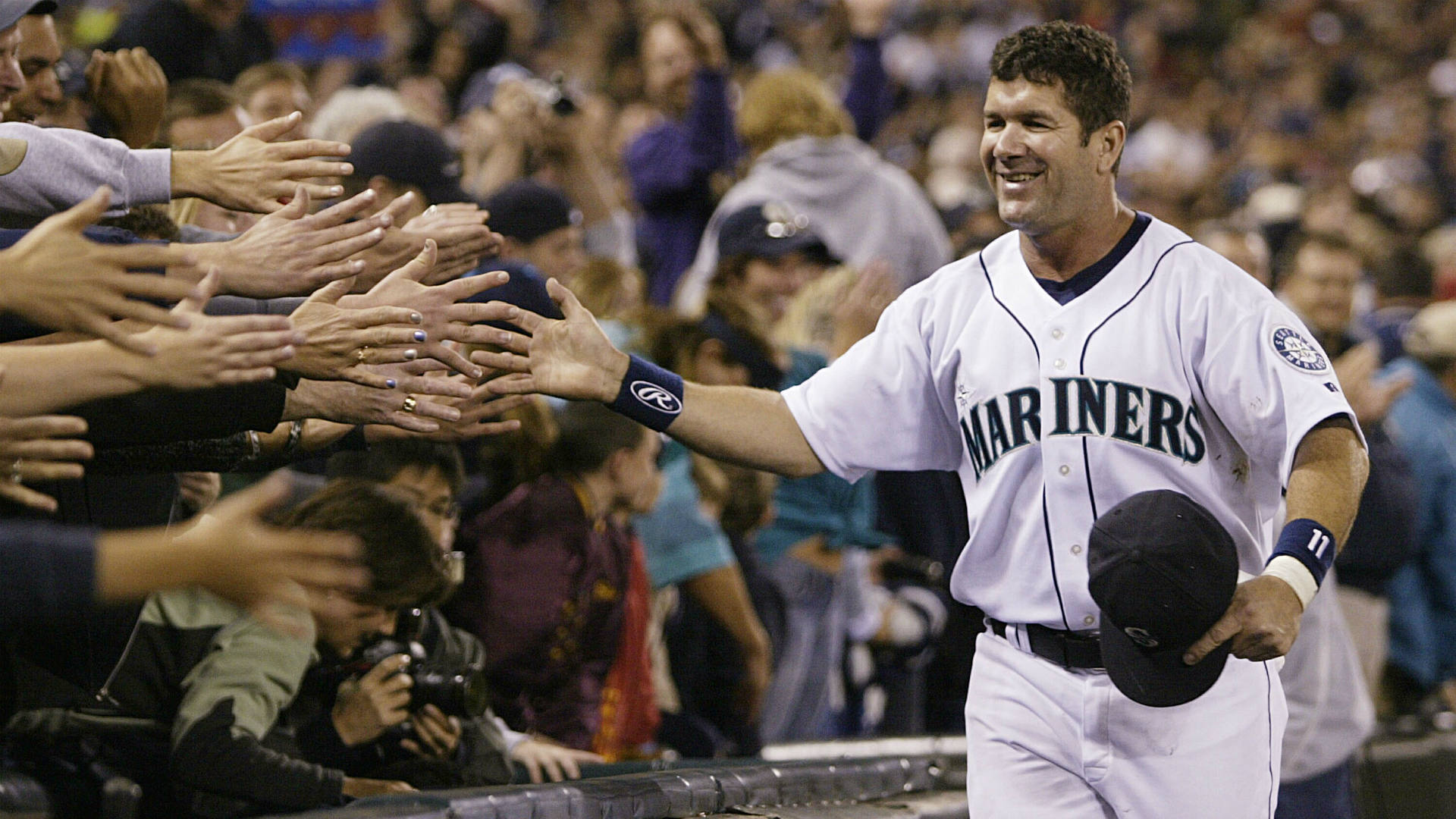
The Bone, while naturally a right fielder, slides into left to accommodate for Ichiro's cannon arm. Buhner is one of the most beloved Mariners of all-time, and should be a great addition to this team. His three consecutive 40 home run seasons is amazing, and even if the rest of his career was only average, that alone earns him a spot in this line-up (just barely over another fan favorite, Raul Ibanez). Not to mention it would be an excuse to bring back good old "Buhner buzz nights". 

CF: Ken Griffey junior (1989-1999, 2009-2010) 70.4 WAR, 10 time All-Star, 10 Gold Glove Awards, 7 Silver Slugger Awards, 1997 AL MVP, 4 time HR champion, 2016 HOF inductee


I don't even know what I could say that hasn't already been said about the Kid. Griffey is the most loved Mariner of all-time, and quite possibly one of the most loved and cherished baseball players in the history of the game. Injuries derailed his career after he left Seattle, but his numbers while in the Emerald City are extraordinary. 10 All-Star game appearances, 10 gold gloves, the 1997 MVP award, etc etc. He was of course the final run in the 1995 ALDS against the Yankees, scoring from first on the infamous "double" and sliding into home, forever immortalized on a big mural outside of Safeco field and by a bar in Capitol Hill, simply called "95 Slide".

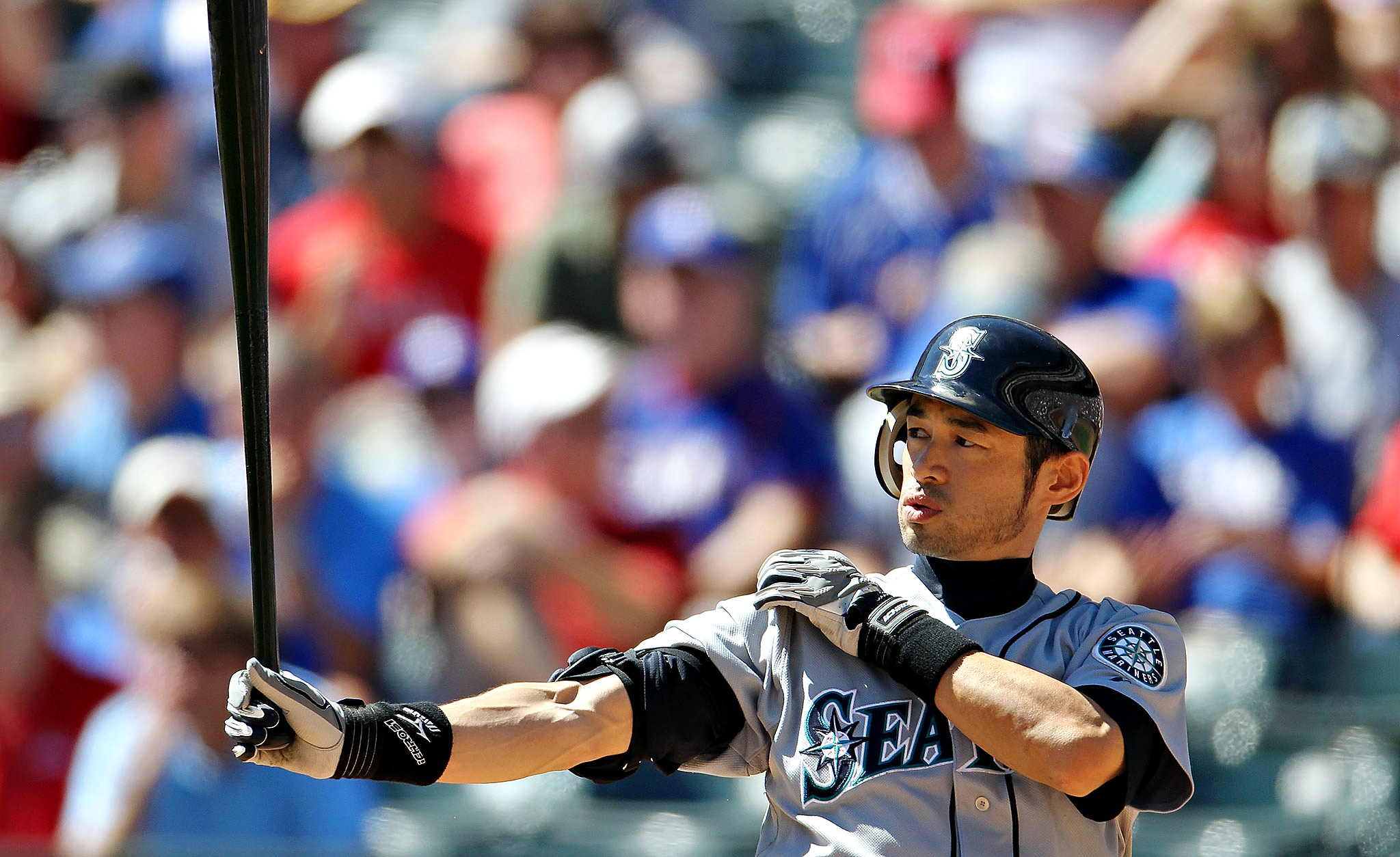
RF: Ichiro* (2001-2012) 56.8 WAR, 10 time All-Star, 10 Gold Glove Awards, 3 Silver Slugger Awards, 2001 AL MVP, 2001 AL Rookie of the Year, 2 Batting Titles


Ichiro took the baseball world and flipped it completely upside down in 2001, and remained one of the best players in the game for an entire decade. I'll never forget being an 11 year old kid during that 2001 season and watching Ichiro get hit after hit after hit. I remember the baseball analysts eating their words, having all said that his success in Japan wouldn't translate over to the American game. Ichiro is an international treasure, and numbers he put up here in Seattle, while incredible, don't do him justice for the impact he had on the game itself. I am looking forward to him eclipsing 3000 hits (here in the MLB, he has well over 4000 including Japanese stats) and already can't wait to hear his HOF speech 6-7 years down the road.

DH: Edgar Martinez (1987-2004) 68.3 WAR, 7 time All-Star, 5 Silver Slugger Awards, 2 Batting Titles


Without a doubt the easiest selection on this roster. Edgar is not only the best DH in Mariners history, he's the best DH of all time and it's really not debatable. The award each year for the DH of the year is called the "Edgar Martinez Award" for a reason. Edgar is the only non-active hitter on this roster who spent his entire career with the Mariners, and is in first place in Mariner team history in runs, doubles, total bases, RBI's, on-base %, walks, OPS+, and sac flies. He is one of very few players to finish his career with a batting average higher than .300, an OBP higher than .400, and a slugging percentage higher than .500. Many great hitters are lucky to do that for a single season, Edgar did that for a career. Edgar very clearly deserves the DH spot on this team, and will hopefully hear his name called for induction into the Hall of Fame soon.

Bench:


Dave Valle - C
John Olerud - 1B
Harold Reynolds - MIF
Adrian Beltre - 3B
Raul Ibanez - LF
Mike Cameron - CF

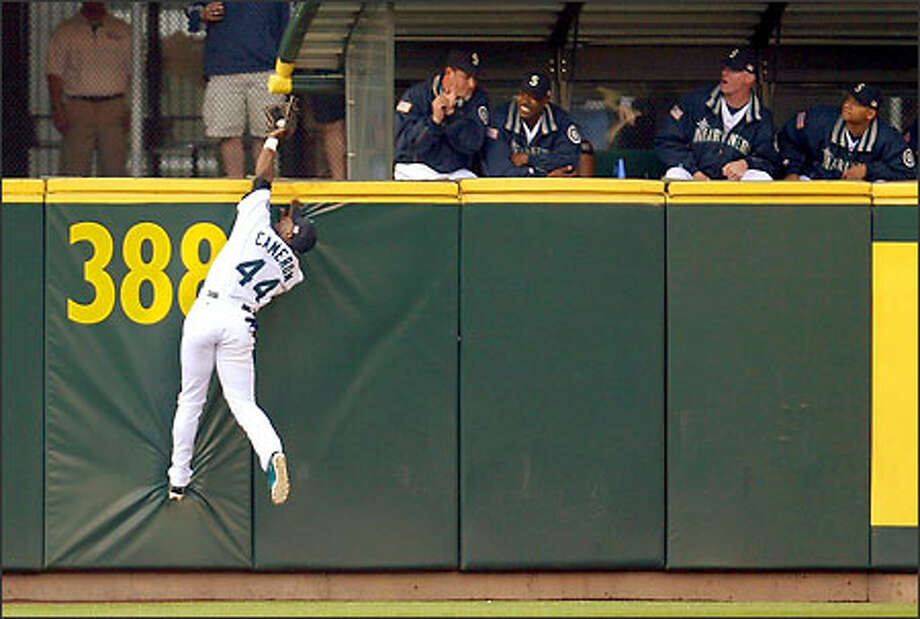
A lot of these players just missed starting nods on this team. Valle is very clearly the 2nd best catcher in Seattle history, and has remained involved in the Mariners organization. Olerud was an all-star and a 3 time gold glove winner in Seattle, and his .388 OBP during his 5 years there is incredible. Reynolds wasn't a great hitter, but his speed (228 steals, 48 triples) and defense (3 gold gloves) earn him a role as a backup. Adrian Beltre narrowly missed starting on this team, and will provide great defense and RH power off the bench. Ibanez and Buhner I went back and forth on for quite a while. Ibanez averaged about 23 home runs and 89 RBI's per season with Seattle, and was a natural left fielder. I went with Buhner, but Ibanez certainly wouldn't be the worst choice in the world. Mike Cameron narrowly edged out former Mariner Phil Bradley for the last bench spot. Bradley hit for a higher average, but Cameron had more power and was a superb defensive CFer.

Rotation:

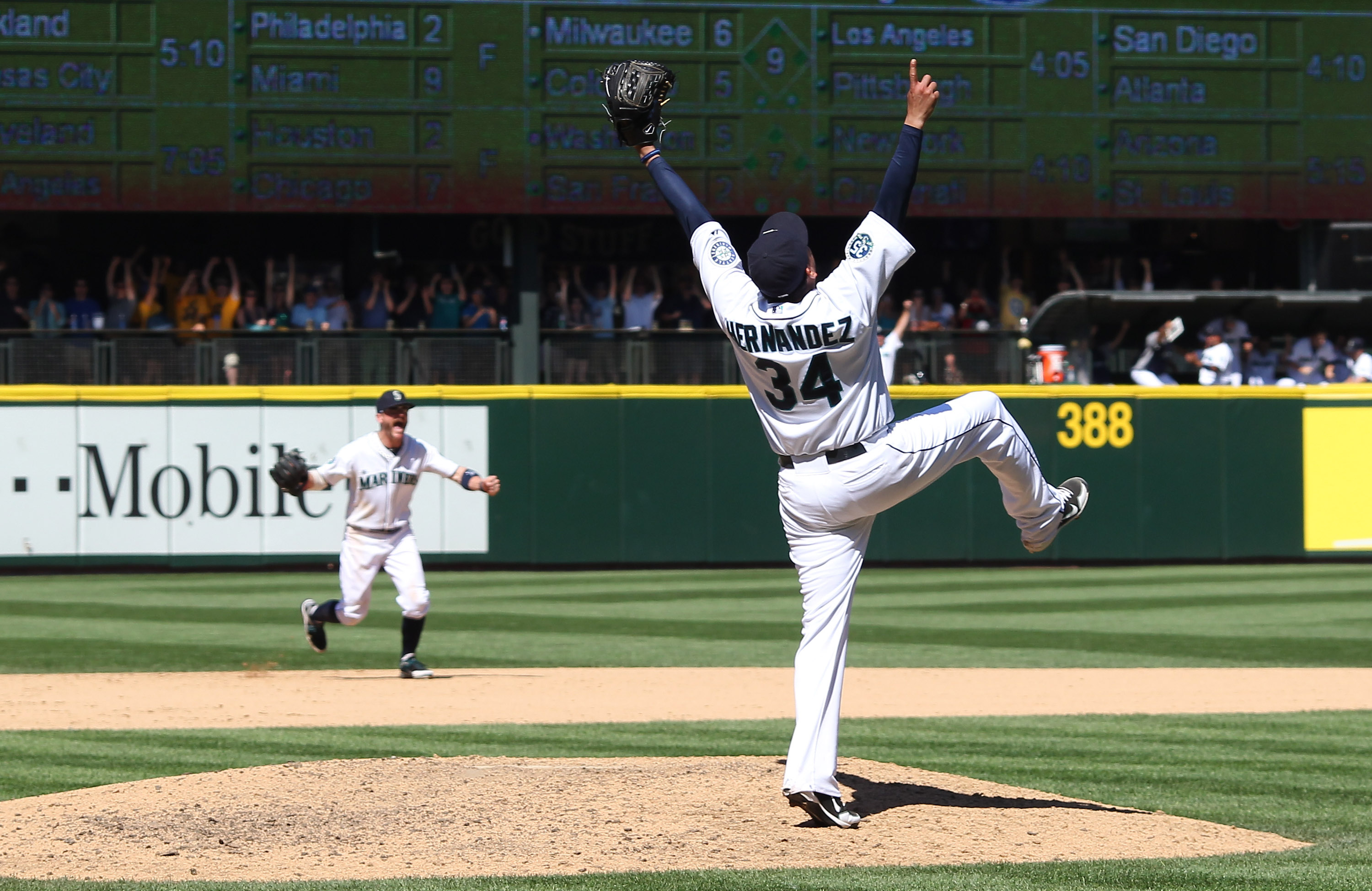
SP: Felix Hernandez (2005-active) 143-102, 2010 Cy Young award, 6 time all-star, 2 time ERA champion, Perfect game (8/15/2012)


The King. Felix will go down on the shortlist with Edgar, Griffey, Ichiro and Randy Johnson as the greatest Mariners of all-time, and as future Hall of Famers (Edgar better get his due soon). As I'm writing this, he just tied Randy Johnson for most strikeouts in Mariner history, and he's only 30 years old. Here's to hoping he stays a Mariner for life.

SP: Randy Johnson (1989-1998) 130-74, 1995 Cy Young award, 5 time all-star, 1995 ERA champion, 4 time strikeout champion, No-Hitter (6/2/90), 2015 Hall of Fame inductee


Randy Johnson might be the best left-handed pitcher of all-time, and he spent about half of his storied career in Seattle, where he made 5 all-star games, won a Cy Young award, and struck out over 2000 hitters. It hurt when Randy went into the Hall of Fame wearing a Diamondbacks hat, but it doesn't take away his incredible accomplishments as a Mariner.

SP: Jamie Moyer (1996-2006) 145-87, 2003 All-Star, 3 top 6 Cy Young finishes (Mariners team leader in wins)


Moyer is the franchise leader in Wins (for now, Felix is on his back) and is one of the longest tenured Mariners of all time. Known for his incredible control and agelessness, Moyer threw ten years for the Mariners, and was a 20 game winner during the incredible 2001 season. Even though he was not known for striking hitters out, he is third all-time in K's in franchise history.

SP: Freddy Garcia (1999-2004) 76-50, 2 time all-star, 2001 ERA leader, 2 top 10 Cy Young finishes


The "Chief" may not have been on the Mariners for a super long time, but he made the most of his time here. He was the ace pitcher of the 2001 team, going 18-6 with a league leading 3.05 ERA and finishing third in Cy Young voting. He was a two time all-star, and is (allegedly) the reason a teenage Felix Hernandez wanted to sign with the Mariners (and why he wears #34).

SP:  Hisashi Iwakuma (2012-active) 47-26, 2013 all-star, No-Hitter (8/12/15)


There are a lot of guys who were considered for this spot (Mark Langston, Chris Bosio, Mike Moore, Floyd Bannister, etc) but ultimately Kuma had the best numbers, and (similar to Seager) has a good opportunity to improve upon them in the next few years. Kuma has made 99 starts in a Seattle uniform, and has accrued a 3.18 ERA with 563 strikeouts, compared to only 131 walks. He's already 35, but a few more solid years out of Kuma will make him a mainstay in the all-time Mariners rotation.

Bullpen:


Norm Charlton
Jeff Nelson
Arthur Rhodes
JJ Putz
Kaz Sasaki - CL

With the exception of Putz, all of these relievers were members of the 2001 team, and boy were they nasty. Rhodes in particular had a ridiculous 2001 season, going 8-0 with a 1.72 ERA, 0.85 WHIP and a 83/12 K/BB ratio. Sasaki wasn't around too long, but was clearly the best closer the Mariners have ever had. Charlton was a nasty Loogy during his time, and Jeff Nelson had one of the best breaking balls I have ever seen. Putz didn't spend a huge chunk of time in Seattle, but his 2007 season (1.38 ERA, 40 saves, 82/13 K/BB ratio) is one of the best in Mariner history.

Batting Lineup:
1. Ichiro - RF                                            .322/.366/.418    9hr 55rbi 38sb
2. Alex Rodriguez - SS                             .309/.374/.561    27hr 85rbi 19sb
3. Edgar Martinez - DH                            .312/.418/.515    24hr 99rbi
4. Ken Griffey, Jr. - CF                             .292/.374/.553    36hr 105rbi
5. Alvin Davis - 1B                                   .281/.381/.453    20hr 83rbi
6. Bret Boone - 2B                                   .277/.336/.478    21hr 77rbi
7. Jay Buhner - LF                                   .255/.360/.497    22hr 69rbi
8. Kyle Seager - 3B                                  .262/.328/.433   23hr 79rbi
9. Dan Wilson - C                                    .262/.309/.384    7hr 42rbi

Strengths

This team is an on base machine. In fact, the lowest OBP among the 1-5 hitters in the order is .366, by Ichiro. This squad would put a lot of people on base, and RBI machines like Martinez, Griffey and Davis should have no problem bringing them home. The 2-8 hitters all averaged 20+ HR per season, so this team is going to drive the ball out of the park as well.

Defensively, this is a very good squad. Between the starting 8 fielders, they have a combined 25 gold glove awards (and that is with Reynolds, Cameron, Beltre and Olerud on the bench). Wilson is solid behind the plate, Boone and A-Rod are good up the middle, Seager is a great 3B, and Griffey and Ichiro each have ten Gold Glove awards.

I don't know that you will find a 1-2 punch better than Felix Hernandez and Randy Johnson. That's the scariest, nastiest combination to have to face I can even imagine. It feels like any series with those two pitching would be two wins, guaranteed.

Weaknesses

No disrespect at all to Moyer, Freddy and Kuma, but the rotation does take a noticeable drop-off after Randy and Felix. This rotation would be filthy against any regular MLB teams, but if it were facing other team's top 25 rosters, I think these rotation pieces would leave some to be desired.

Likewise, the bullpen is good, but not great. The Mariners have a weird history of closers being good for one season, then awful the next (Guardado, League, Aardsma, Wilhelmson, Rodney, etc.). Sasaki was nasty, but didn't play in the MLB all that long. Rhodes and Nelson are great, but after that it thins out a bit.

Hitting wise there isn't much to complain about on this team - they are going to get on base and they are going to mash.

Future members


Looking at the current organization, there is only one player who I think is making a very good case for inclusion on this team, and that's Robinson Cano. 2B has been a great position for the Mariners historically, but if Cano hits like he has been this season, and like everyone knows he is capable of, he will have a chance to become the greatest 2B of all-time, and would most certainly put himself on this roster.

There are a few guys who are on the right track to someday make this team, assuming they continue to perform well (and stay on the Mariners): Taijuan Walker and Ketel Marte. Walker has had his ups and downs, but is only 23 and has shown some electrifying stuff when he's on. It's certainly not unreasonable to believe if he stays with the Mariners that he will take a rotation spot on this team. Likewise, Ketel Marte has shown some flashes of brilliance and if he stays with Seattle, could become one of the best shortstops they've ever had. That's a lot easier to do when your competition is Yuniesky Betancourt, Brendan Ryan, Rey Quinones and Josh Wilson.

Final Note:

13 of the 25 players on this team were members of the 2001 Mariners, really emphasizing how dominant that team was to the history of this franchise. The franchise's all-time starting C, 2B, LF, RF and DH were all on that team, as well as 2 SP, four members of the bullpen, and 2 bench players.


The Mariners have had quite a few talented players play for them, and I'm sure a lot of people could think of players who they think deserve a spot on this roster. I would love to hear what you think! Likewise, suggestions for future blog posts are always welcome as well. Enjoy!

Friday, April 8, 2016

Vladimir Guerrero and the Hall of Fame

(My goal during the 2016 season is to write one blog post per week and publish them every Friday. Many of them will be Hall of Fame evaluations, but I am happy to get feedback on anything you all want to read about, or specific players you would like me to evaluate. Thanks for reading!)

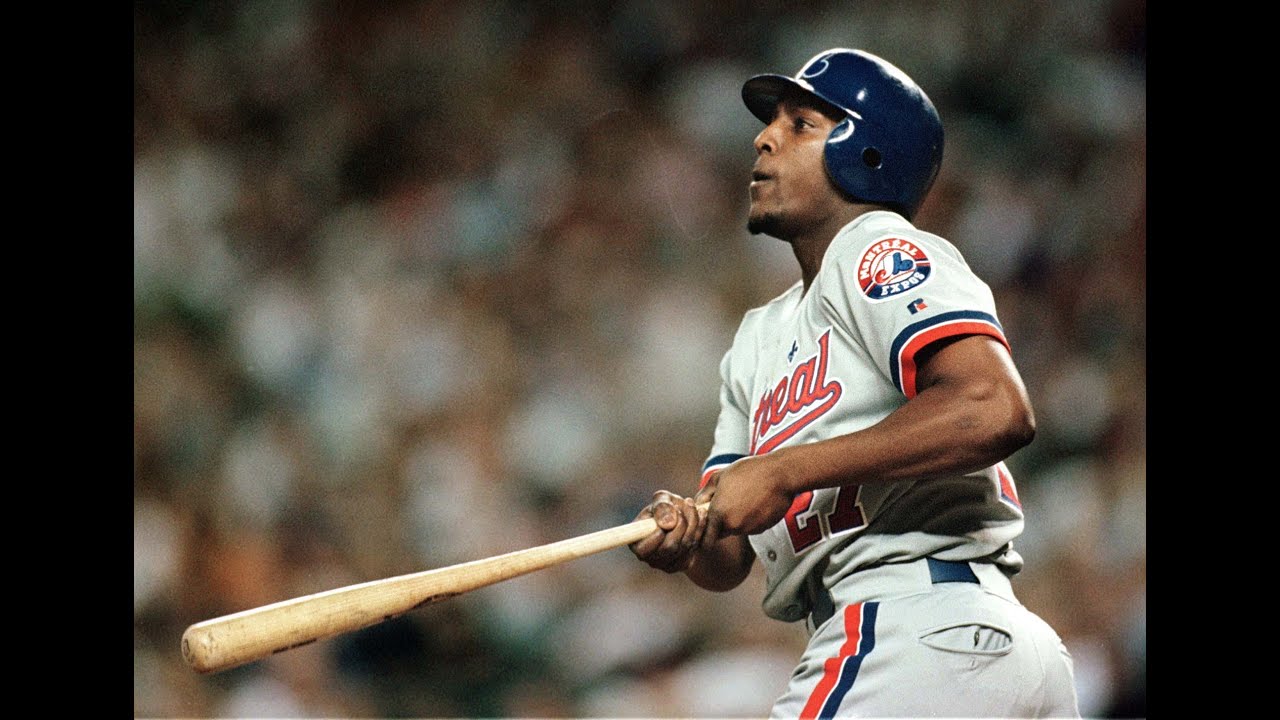
Ken Griffey junior and Mike Piazza, two of the best hitters of the 90's and early 00's, will officially be inducted into the Baseball Hall of Fame this July. After the ceremony, attention will inevitably turn toward the 2017 Ballot and people will begin to debate which of the many fine candidates from that class will be the next to hear their name called in January. Among the many impressive carry-overs from last years ballot (Jeff Bagwell, Tim Raines, Trevor Hoffman, Mike Mussina and Edgar Martinez) there are three newcomers who figure to challenge for the 75% necessary for HOF induction. The most talented of the three, Manny Ramirez, will likely have a hard time earning enough votes as he is the first player to appear on the ballot who was suspended during his career for using PEDs. Likewise, former catcher Ivan 'Pudge' Rodriguez has a large steroid cloud hanging over him as well, having been mentioned by name in Jose Canseco's novel Juiced. Voters tend not to favor anyone suspected of PED use, so Pudge seems unlikely to get a lot of support. The last of the prominent newcomers is former Expos and Angels slugger Vladimir Guerrero. Vladdy finished his illustrious career with 449 home runs, 1496 RBI's, 181 steals and a triple slash line of .318/.379/.553. He was a nine time all-star, an 8 time Silver Slugger award winner, and the 2004 AL MVP. But is that enough for Cooperstown to come calling?

The case for Vladimir Guerrero and the Hall of Fame:


From an offensive standpoint, Vladimir Guerrero was a force to be reckoned with during his 16 year career. Below is a chart detailing where he ranks all-time in a variety of different hitting categories:

Category Total All-Time Rank
WAR 59.3 123
BA 0.318 56
SLG% 0.553 24
Runs 1328 116
Hits 2590 84
Total Bases 4506 47
Doubles 477 84
HR 449 38
RBI 1496 54
OPS+ 140 77
XB Hits 972 44
IBB 250 5

Guerrero is in the top 50 in home runs, total bases, extra base hits, and career slugging percentage (he just missed top 50 in RBI's as well).

Additionally, while he was not known for his eye at the plate, he was such a feared slugger that he drew an incredible 250 intentional walks, good for 5th all time behind Barry Bonds, Albert Pujols, Hank Aaron, and Willie McCovey (note: this stat wasn't tracked until 1955).

Guerrero was not just a "compiler" however, as he arguably was one of the most complete players in the game during his peak. Guerrero had 8 seasons with a .300+ BA, over 30 HR, and over 100 RBI's. He hit 35+ home runs 5 times, and hit over 40 HR twice. He led the league in runs (2004), hits (2002), total bases (2002 and 2004) and IBB (2000, 2005-2008).

Guerrero had power (449 HR and a .553 slg%) speed (181 steals) hit for average (.318, 4 seasons over .330) and had a cannon arm (27th all time in RF assists). He only really lacked overall defensive skill to be a complete five tool player.

Baseball-Reference's HOF Monitor and HOF Standards score Guerrero very highly. Guerrero has a HOF Monitor score of 209 (a likely HOFer is 100) and a HOF Standard score of 58 (average HOFer is 50). Additionally, his gray ink score (which is a measurement of top 10 finishes in different offensive categories) is 166, where the average HOFer is 144.

Against Vladimir Guerrero and the Hall of Fame:


Guerrero falls just short of many of the counting stats that old-school BBWAA voters like to see in their Hall of Famers. He falls 51 home runs short of 500, 4 RBI's short of 1500, and 410 hits short of 3,000. As a power hitter, it is probably unfair to expect Guerrero to have eclipsed 3000 hits, but nevertheless, there are a lot of voters out there who like round, pretty numbers, and Guerrero falls short in that area.

Right field is a pretty deep position in the Hall of Fame, and while Guerrero has great numbers, he doesn't quite add up to a typical HOF RF. There are 24 rightfielders in the Hall of Fame, and those players averaged a 73.2 career WAR, a 7 year peak WAR of 43, and a JAWS rating of 58. Guerrero only has a 59.3 WAR, a 41.1 7 year peak WAR, and a JAWS rating of 50.2. His peak WAR and JAWS rating are just short, but his total WAR falls considerably below what most HOF right fielders have accrued. In fact, his 59.3 career WAR falls just behind Bobby Abreu, Keith Hernandez, and Jim Edmonds, all great players but none who are in the Hall of Fame.

Part of the reason his WAR is lower than many of his counterparts is his poor OF defense. As was noted earlier, Vladdy had a cannon arm. Unfortunately, the rest of his OF defense was quite poor. He accrued a -10.7 defensive WAR in his career, and a UZR (ultimate zone rating) of -17.2. For those who like more traditional stats, Guerrero had 125 errors as a right fielder, good for 5th all time, despite only being 21st in games played. The Hall of Fame rarely takes defense into play (especially outfield defense) but the damage it does to his career WAR could have an impact on some of the newer, more sabermetric-minded voters.

Black Ink (as opposed to Gray Ink) is the measurement of the # of times a player led the league in various offensive categories. Guerrero has a black ink score of 6, whereas the average HOFer is 27. Guerrero was rarely a "league leader", and when he was he led mostly in IBB and twice in Total Bases. Nothing to be ashamed of, but he never led the league in home runs or RBI's, never won a batting title and never led in OPS+ or Slugging %. In all fairness, Guerrero's career overlapped with sluggers like Barry Bonds, Albert Pujols and fellow HOF ballot-mate Manny Ramirez, but often the voters place a lot of value on being the best in the league, and Guerrero will have a really hard time convincing anyone he was the best player in the league any given year (although he did win the MVP award in 2004).

I don't think this is a legitimate reason not to vote for him, but I think playing so many of his dominant years in Montreal will hurt his familiarity with some of the voters, which could cost him votes. I think that as a voter you should do your due diligence and if you aren't familiar enough with a player of Guerrero's caliber than you probably aren't the right person to be electing players into the Hall of Fame, but I fear some voters will ignore him on election day for some of the bigger name players, especially on an incredibly crowded ballot (Ramirez and Rodriguez will join holdovers like Bonds, Clemens, Sheffield, Sosa, Bagwell, etc).

Verdict:


Vladdy is a Hall of Famer in my book - his ridiculous offensive abilities, hitting for both power and average, while having speed on the base paths, made him a tremendous weapon and one of the best players in the game for a very long period of time. He never had any serious PED allegations around him, something that I think will help him with some of the voters. I've always found Vlad's story to be pretty compelling (completely unheralded, showed up at a tryout in shorts and crushed the ball, got signed almost immediately) and I think he was one of the most athletic, talented baseball players on the planet for nearly a decade. In my mind, no doubt he's a Hall of Famer.

Prediction:

Man, the ballot is crowded next year. Obviously Bonds and Clemens will continue to get votes, and holdovers Jeff Bagwell, Tim Raines, Trevor Hoffman, Mike Mussina, Edgar Martinez, and Curt Schilling will occupy a lot of voters' ballots. Tack on Manny Ramirez and Ivan Rodriguez, who will certainly take up a lot of votes as well, and it gets very hard to predict how the voters will handle someone like Guerrero. Because very few players are going in in their first year (Bagwell is still on the ballot, Piazza and Biggio took a few years) I have a hard time expecting that Guerrero will go in right away, but I do think eventually he will get enshrined, it just might be 4-5 years down the road. He will get my (fictitious) vote each year until then.

Wednesday, March 30, 2016

2016 Baseball predictions

Baseball is just around the corner! I've done preseason predictions the last few years, and even though all it really does is prove to me how little I actually know about the MLB, I'm going to trot out there again and give you 15 predictions for the 2016 season. I welcome any feedback!

1. Miguel Cabrera finishes the season with .330/30/100.

It all depends on his health for the big fella. If he can stay healthy and play in over 155 games, the HR/RBI numbers should get there, although hitting over .330 will be a challenge. Fangraphs uses two very advanced metrics to estimate a players full season output, called ZiPS and Steamer.

ZiPS has Miggy at .306/24/88 in 131 games
Steamer has Miggy at .313/25/91 in 133 games.

A 155+ game season should get Miggy to the 30/100 range, and I think he will repeat or at least come close to the .338 he hit last year, especially with a lot of power surrounding him in the line-up.

2. Byron Buxton plays a full season, shows why he is a top prospect.

I didn't put any tangible measurements on this prediction, which will make it harder to judge at the end of the year. However, as of right now, Buxton is penciled in as the starting CFer for the Twins, and if he manages to hold onto that job all year and post double digit home runs and steals, I think we will have our answer. Most predictions have him only hitting around .260, but I think he will rebound from his poor showing in the MLB last year and put up big numbers. Mike Trout hit .220/.281/.390 in his 40 game debut in 2011, setting him up for his incredible 2011 season. Maybe Buxton will do the same.

3. Jonathan Schoop finishes with 25+ home runs.

Schoop had a power breakout at the plate last season, blasting 15 home runs despite missing half the season with an injury. If Schoop is able to stay healthy for a full season, he should get an opportunity to mash toward the bottom of an extremely power heavy line-up. Having guys like Machado, Davis, Trumbo, Alvarez, Jones and Wieters hitting around him should allow him to get a lot of fastballs, and a small park like Camden Yards should see the ball leave the yard quite a bit.


4. Marcus Stroman is the 2016 AL Cy Young winner.

Marcus Stroman has made 24 starts in his young career, tallying a 3.31 ERA, a 1.14 WHIP, and a blistering 129/34 K/BB ratio. The fact that he is only 24 years old, pitches for a team that should score him basically 5 runs every night, and that last season's injury should not affect his ability to pitch (since it happened to his knee) should give him an incredible opportunity to win 20 games and have outstanding peripheral numbers. He will have to compete with regular Cy Young contenders Felix Hernandez, Chris Sale, David Price and Corey Kluber, not to mention up and coming arms like Chris Archer and Carlos Carrasco, but Stroman is as good a bet as any to take home the award.


5. Nick Castellanos finally breaks out, becomes big piece for Tigers.

Castellanos had been, simply put, a bad MLB player for the first 1.5 years of his career. However, unbeknownst to a lot of fans, a switch flipped in Castellanos over the last half of last season. While the Tigers sold off and limped through the 2nd half, Castellanos came alive to the tune of .275/.323/.481 with 22 home runs. He may never be good with the leather, but a .270+ batting average and 30 home runs would go a long, long way toward fans forgetting about his abysmal first two years in Motown.

6. Didi Gregorius hits more home runs that Alex Rodriguez.

I have to have one ridiculously, comically bold prediction each year, mainly for the one time I get it right and can tell everyone I called it. Gregorius played in 155 games last year and managed to muscle 9 HR, even while playing in the band box that is Yankee Stadium. His Line Drive % improved from 19.6% in 2014 to 21.2% last year, but his fly ball % went from 42.9 down to 34.1%, and his HR/FB ratio dropped from 6.4% to 6%, despite moving to the confines of Yankee Stadium. I am anticipating a slight bump in fly balls for Didi (career rate is 38.2%) which should hopefully help him lift 12-15 home runs this season, assuming he stays healthy. Now of course 15 home runs (maximum) should not beat Alex Rodriguez, but something tells me A-Rod is not going to repeat last years surprise performance with the bat, and if he misses any time with an injury I can see him losing playing time to Beltran/Teixeira at DH. Again it is bold, but if A-Rod can't get it done the Yankees will replace him in the line-up, whereas they have much fewer options to replace Didi with, especially since he at least can hang his hat on having superior glove work.


7. Ichiro falls just short of 3,000 hits.

If Ichiro hits .250 on the season (ZiPS and Steamer both predict almost exactly that) he will need 260 at-bats to obtain his 65th hit of the season, and 3000th hit overall. Ichiro had 398 AB's last year, and 359 AB's in 2013, however his role is expected to be diminished this season as long as the Marlins young trio of OF stays healthy. I expect that Ichiro will earn around 200 at-bats this season, which would require him to hit .325 in order to obtain 65 hits. Something like 52 hits in 200 at-bats (.260 BA) would put Ichiro only 13 hits shy of 3k. I expect him to land somewhere around that margin, and am hoping he sticks around next season to get up to 3k.

8.  Adam Laroche plays in the MLB this season.

I think once the dust settles on this whole Drake Laroche situation, Adam will want to play baseball again, and I would imagine teams will be interested in adding his services. Taking all this time off, coupled with his poor season last year, will most likely relegate him to a PH/bench role, but I wouldn't be surprised to see someone give him that opportunity, especially a contending team in need of a bench bat.

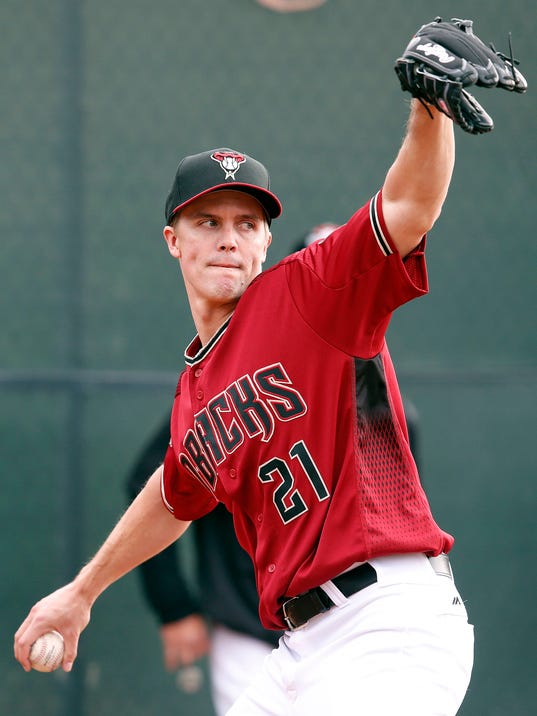
9. Zack Greinke is not the best SP on the Diamondbacks.

Again, no specific measurements can be used to 100% confirm this at the end of the year, but I have a feeling one of Shelby Miller or Patrick Corbin will end up being a more productive pitcher off the bump than Greinke. Greinke is due for a regression after last years ridiculous numbers, and I think Corbin will bounce back very nicely from his injury, and Miller will flourish with a change of scenery (and some offense!).


10. Carlos Rodon finishes with 200+ strikeouts.

Rodon put up an 8.98 K/9 in his 139 big league innings last year, after putting up a ridiculous 51 K's in 34.2 MiLB innings. Both ZiPS and Steamer project him to improve his K/9 to over 9.0 next season, and as long as he is able to pitch at least 180 innings, 200 K's looks mighty attainable for the young lefty with the nasty slider. The biggest hang up will be an innings count, and if the White Sox fall out of contention it seems likely that Rodon, who threw 149 innings between all levels last year, will get capped around 160 IP or so, making 200 K's much less likely.

11. Kyle Schwarber hits 40 home runs. 

I tend to try and make somewhat bold predictions, but this one feels kind of lazy. Schwarber blasted 16 last season in only 273 PA's, which was a 38 home run pace. Assuming he gets to play nearly every day (which is the plan for the Cubbies) he should be able to reach at or near 40 home runs this season. His future is not behind the plate, so if the Cubs can get him in the line-up on a daily basis in LF, he should be able to put up big #'s in a very vaunted Cubs line-up.

12. AL Play-off teams: Astros, Tigers, Blue Jays. Rangers and Royals in the Wild Card.

A lot of people are high on the White Sox and the Indians, but I don't feel either team has enough offensive oomph to challenge in that division. Red Sox still have too many holes in the infield and rotation, and the Yankees didn't improve enough to make a big jump in that division.

13. NL Play-off teams: Giants, Cubs, Mets. Nationals and Dodgers in the Wild Card.

Bye bye Cardinals! I felt weird only selecting one NL Central team, since that division is stacked, but the Cardinals did virtually nothing to improve their team and I think the Pirates are going in the wrong direction. Meanwhile the Nationals have a filthy rotation and improved their offense, and the Dodgers, despite losing Greinke, are still scary good.

14. Blue Jays and Cubs play for the World Series.

What a World Series this would be. Bombs, on bombs, on bombs. Don't get me wrong there are some talented arms in this bunch (Stroman, Arrieta, Lester etc) but this would be a very offensive series, especially since every game would be played in either the Rogers Centre or at Wrigley.

15. I'm gonna do it. I'm going to make this prediction. Cubs win. 

Oh boy.

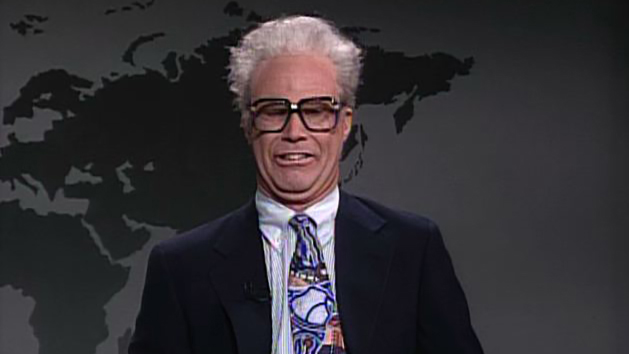
Bonus 16th prediction: Will Ferrell dresses as Harry Caray and yells "Cubs win! Cubs win!" and it becomes an internet sensation.

Wednesday, January 20, 2016

2016 Hall of Fame Congrats and reactions

In order to get my thoughts out in a timely fashion (which has already failed), I've decided to give my rapid fire reaction to the Hall of Fame voting that took place this month.

1. Congratulations to Ken Griffey jr and Mike Piazza!


First and foremost, time to offer congrats to two of the best hitters I have ever watched play the game of baseball. Piazza spent most of his career in the NL and on the East Coast, so I did not grow up watching him nearly as much as Junior, but his accomplishments speak for themselves. 427 Home runs (396 as a catcher) is an incredible accomplishment, and he has put himself squarely in the conversation of best hitting catcher of all time. After three years of waiting (no doubt due to whispers of alleged PED use) Piazza broke through in 2016 with 83% of the vote. A big congrats to him, his family, and Mets/Dodgers fans everywhere.

The Kid. The man who hit a home run in 8 consecutive games, who nearly broke his wrist jumping into a wall to get an out, who hit a home run right after his father back in 1991, and who scored the winning run on "The double" to send the Mariners into the ALCS in 1995 is now forever immortalized in Cooperstown. In what was basically a formality, Griffey received an astonishing, record breaking 99.3% of the votes, breaking Tom Seaver's 14 year old record of 98.2% and cementing himself as one of the all-time greats. I grew up watching him, and will forever remember his effortless swing, amazing outfield plays, and of course the backwards hat (which Bryce Harper has suggested should be reflected in his HOF plaque). Congratulations Junior, and I look forward to your HOF speech in July.

2. A small but impactful shift in BBWAA voters


It may not have seemed all that noticeable to a casual fan, but something happened this season on the ballot that has created hope for many players who may have seemed lost before. The BBWAA "cleaned out" a lot of their previous voters, choosing to remove voters who had not been covering baseball in recent years. This dropped the number of voters by around 100. That, coupled with a bigger group of new voters (who have covered baseball for at least 10 years) seemed to create a shift in voting philosophies. This shift affected quite a few players pretty substantially. Six players received at least a 10% boost from last year: Mike Piazza (+13.1%), Jeff Bagwell (+16.9%), Tim Raines (+14.8%), Edgar Martinez (+16.4%), Mike Mussina (+19.4%), Curt Schilling (13.1%), and Alan Trammell (+15.8%).

Bagwell (71.6%) and Raines (69.9%) seem very likely to finally make the leap over the 75% necessary for induction next year. Notable were the shifts to Mike Mussina and Edgar Martinez, who before seemed destined to remain between the 5% necessary to stay on the ballot, and the 75% necessary to be inducted. However, with jumps all the way into the mid 40's, both now have a fighting chance of seeing themselves in Cooperstown before their time is up on the ballot. Mussina has seven years of eligibility remaining, Martinez only three. Edgar will need about 1/3 of the voters to change their tune regarding Designated Hitters and the Hall of Fame in the next three years, which seems (unfortunately) pretty unlikely. With a 16% jump last year, however, it is possible!


Last point on the shifting voting patterns is the small but steady growth in support for baseball's favorite stars, Barry Bonds and Roger Clemens. Bonds and Clemens each gained about 8% last year, leaving them still well short of induction, but trending the right way. The new voters favored both Bonds and Clemens, and many voters (including Oregon voter John Canzano) wrote publicly about their changing stance on voting for PED users. Whether this change will eventually enshrine Bonds/Clemens remains to be seen, but for now it appears they will stay on the ballot, collecting somewhere below 75% of the vote and hurting the candidacy's of other players. Which leads me to my next point....

3. How the Hall of Fame rules are hurting certain players

Player A: .284/.376/.527 with 393 HR, 1199 RBIs, and a 60.3 WAR
Player B: .295/.380/.540 with 407 HR, 1333 RBIs, and a 66.5 WAR

Safe to say these are pretty close right? Both were elite defensive CFers, although neither was quite considered the best of his time.

Player A, Jim Edmonds, fell off the ballot after receiving only 2.5% of the vote, well short of the 5% necessary to stay on the ballot.

Player B, Duke Snider, only received 17% in his first year on the ballot in 1970, before steadily climbing up to 86% in 1980 to reach induction.

The fact that Jim Edmonds, a fringe HOF caliber player, didn't even earn enough to stay on the ballot is a shame. I'm not 100% sold on him being a HOFer (you can read more about my thoughts here) but he certainly merited more consideration than this. He joins Kenny Lofton, Kevin Brown, John Olerud and Lou Whitaker as players who didn't get their fair share in court when it comes to HOF consideration.

Other players, who I have advocated heavily for in the past, are not seeing a lot of support, often due to the "rule of ten" which says that BBWAA writers are only allowed to vote for ten players per ballot. Fred McGriff, Larry Walker, Billy Wagner, Jeff Kent and the aforementioned Jim Edmonds are players who are getting bumped for being the 11th or 12th most deserving candidate on the ballot. The Hall of Fame should simply be about who deserves enshrinement, not "which ten of these players" deserve it. The Hall of Fame's fear is that allowing voters as many votes as they want will create a situation where tons of players are getting elected, but last year less than half of the voters used all ten of their votes, which proves that this would not be the case. Many of the voters who used all ten would have happily extended votes to McGriff, Mussina, Walker, etc had they been able to, and we might not have seen such a brief end to the HOF candidacy of Jim Edmonds.

4. 2017 HOF ballot and Predictions

I've never been known for my attention span, so now that Piazza and Griffey are sailing into Cooperstown, let's take a look forward and see what the 2017 class has in store for us. The way I see it, three prominent players will be joining the ballot who should garner serious HOF attention. Those three would be Ivan Rodriguez, Manny Ramirez and Vladimir Guerrero. Magglio Ordonez, Jorge Posada and a slew of players from the epic 2001 Mariners (Mike Cameron, Carlos Guillen and Arthur Rhodes) will also be joining the ballot, but I don't believe they will merit serious consideration. 

The big three, however, should make for some interesting discussion over the next year. Ramirez in particular will be quite the hot button issue. He will become the first player up for induction who actually got suspended by Major League Baseball for PED use during his playing career. How the voters decide to treat Ramirez will say a lot about the future candidacies for David Ortiz and Alex Rodriguez. I predict he will get votes, but nowhere near the 75% necessary. Something around 25-30% seems reasonable (similar to McGwire throughout his candidacy).

Ivan Rodriguez also has a pretty large steroid cloud over his head, having been called out specifically by Jose Canseco as a steroid user in his tell-all novel, Juiced. How the voters handle him will also be interesting to see, as he is very clearly one of the best catchers of all time. Piazza's 4 year wait for induction doesn't do anything to help Pudge's chances, and I don't think we will see him on a plaque anytime soon (if at all).

To me, Vladimir Guerrero is a Hall of Famer. 449 home runs, a .318 batting average, one of the best arms in the business, and great speed make him one of the best and most fun talents of his generation. He appeared by all accounts to do it the right way, and his only knock was his lack of patience at the plate, and the fact that he spent his heyday up north in Montreal. That, however, shouldn't factor in too much, and I believe Guerrero will eventually get enshrined, although I'm not incredibly confident it will happen in year one.


Getting down to brass tacks, I think we will see three inductees next year, all holdovers from this current ballot: Jeff Bagwell, Tim Raines, and Trevor Hoffman. I think Guerrero will be just short and Schilling will continue to inch closer, and I think Mussina and Edgar will climb over the 50% mark on their way toward induction (hopefully).

For me, my ballot will most likely change, but if I had to pick today I would vote for Guerrero, Bagwell, Raines, Hoffman, Schilling, Edgar, Mussina, McGriff, Walker, and Billy Wagner. With apologies again to Jeff Kent - who just doesn't quite make the cut.

I welcome any questions or feedback, these are some of my favorite pieces to write!